


The Differences Between Treating Skin and Structural Facial Aging

There can be confusion among some patients in consultation as to whether their aesthetic concerns are related specifically to changes in their skin or something else. That “something else” are the changes that occur to the deeper, multi-layered soft tissue of the face. This blog post seeks to explain the differences between treating the skin and deeper structural aging and to provide some guidance on appropriate sequencing of these procedures with Dr. Jeffrey Harmon in Cincinnati, Ohio.
What is the difference between improving aged skin and treating deeper, structural aging?
There is a significant difference between treating aged-related changes to the skin and addressing the structural changes to the multiple tissue layers under the skin. The two are often confused, because they can occur at the same time. In fact, it is not uncommon for an individual to present in consultation requesting a facelift to treat their wrinkles. It is important to know that this is a reasonable belief. Unfortunately, a facelift cannot treat facial wrinkles just as a brow lift cannot treat forehead wrinkles, a blepharoplasty cannot treat eyelid wrinkles, a lip lift cannot treat upper lip wrinkles, and a neck lift cannot treat neck wrinkles.
To understand the difference between treating the skin surgically or non-surgically and structural, purely surgical lifting is to understand the evolution of facelifting techniques to the most modern form of deep plane facelift surgery. Skin treatment and facelifting are not interchangeable because, while lifting removes excess skin, skin treatments are intended to improve features of the skin surface without removing excess skin.
How do I know whether to treat my skin or underlying soft tissue structure?
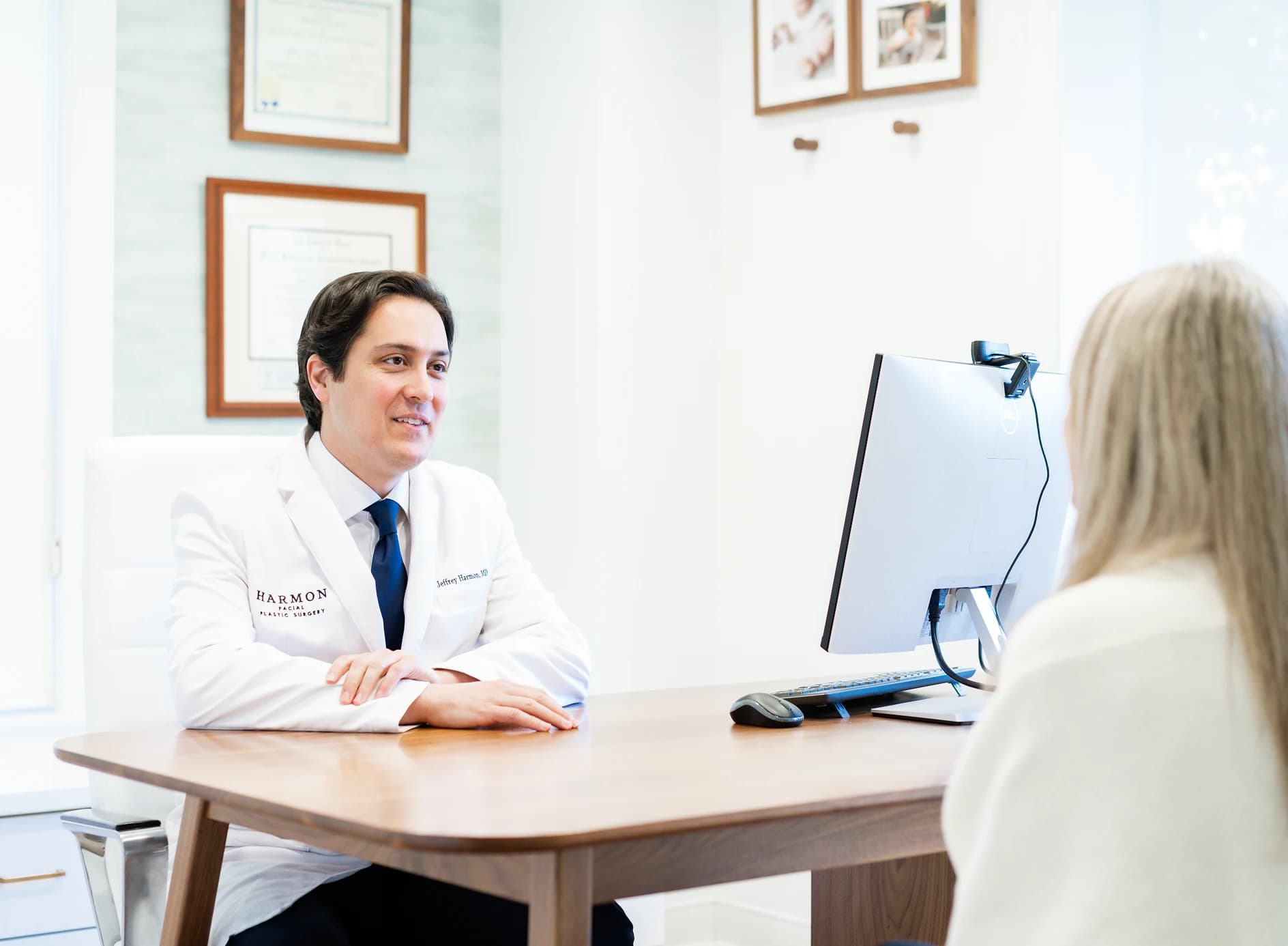
This is largely determined in consultation with Dr. Jeffrey Harmon in Cincinnati, Ohio. He performs a detailed physical exam and listens to each patient’s aesthetic concerns. He also reviews each patient’s medical and facial plastic surgery treatment history to determine what procedures, surgical or non-surgical, they may benefit from.
There are situations in which multiple procedures may be beneficial. There are other situations in which no treatment is advisable.
Broadly, treatments that can improve the skin itself are mostly non-surgical with two exceptions. Those procedures that can improve the underlying soft tissue structure are entirely surgical. This is important to understand because it is common for individuals to present in consultation with Dr. Harmon and stretch their skin, which hides many deep wrinkles. They request surgery to do this. Unfortunately, surgery to simulate this is simultaneously impractical, unsafe, and distorting to the rest of the face.
Table to understand procedures for skin improvement versus structural lifting
The following table helps to clarify whether/what may benefit a patient, pending a consultation, thorough physical examination, and review of medical history to make sure there is nothing that would preclude a specific intervention:
| Condition/Concern | Skin Treatment Option(s) | Structural Treatment Option(s) |
| ||
|
| |
|
| |
|
| |
|
| |
| ||
| ||
| ||
| ||
| ||
| ||
|
| |
|
|
Note the difference between the conditions treated with mostly surgery and those treated with primarily non-surgical interventions on the skin. Treating skin conditions as well as underlying structural changes associated with aging can be complementary and part of a single, comprehensive treatment plan for a patient.
How does Dr. Harmon sequence skin improvement treatments and structural lifting?
The answer is complex and depends on multiple factors, as reflected in his general surgical philosophy. The following are some things that fit his practice pattern, though these are not absolute:
- CO2 laser resurfacing AFTER facelift, neck lift, and lip lift – Dr. Harmon prefers to perform laser resurfacing procedures on facial skin after surgical procedures such as a facelift, neck lift, and lip lift. It is important to emphasize that this is not based on specific evidence or a clinical practice guideline from an academy of medicine. Instead, this is because, if the laser resurfacing procedure is performed after surgery (approximately 6+ weeks postoperatively) then the incisions themselves can be treated, which may accelerate the healing process. Also, Dr. Harmon does not have to turn the laser power down over the small surface area of the skin-only lift around the ears as he would if the laser was performed during surgery. There are, however, exceptions made. He can perform laser resurfacing during surgery, understanding the above limitations, if it is the patient’s preference. It is also okay for patients to undergo laser skin resurfacing before surgery. However, a patient would need to wait approximately three (3) months after laser resurfacing to undergo facelift surgery.
- Regenerative medicine procedures IMMEDIATELY BEFORE skin laser resurfacing – The few (i.e. two) procedures Dr. Harmon offers that may fall under the regenerative medicine category, nano-fat and platelet rich plasma (PRP), are performed on the day of laser resurfacing, immediately before the procedure. He does not perform these procedures absent laser resurfacing and/or surgery. This is because one of the most important reasons for using nano-fat and PRP is to help with healing after the procedure. These substances are also placed around incisions after surgery to help the incisions heal, which is another reason to sequence combined nano-fat/PRP/laser resurfacing for after surgery.
- Botox® or other neuromodulators IMMEDIATELY BEFORE scar revision surgery – These non-surgical treatments are always administered immediately prior to, at the same time as, or by the first post-operative visit after scar revision surgery. The reasoning here is that Dr. Harmon suspects the primary benefit of this treatment is to minimize muscle contraction around the incision that can place tension on it and worsen the appearance of the new incision. Neuromodulators take approximately two (2) weeks to reach maximal effectiveness. He wants the medication to be effective for as long as possible as early as possible after surgery.
Why is Dr. Jeffrey Harmon An Expert Both at Treating Skin and Deeper Structural Aging?
Dr. Harmon is a fellowship trained, double board-certified facial plastic surgeon who is sought after nationally for his expertise and experience treating signs of aging in the face comprehensively.
Dr. Harmon is a fellowship-trained, double board-certified facial plastic surgeon with extensive experience treating both skin and structural facial aging. His approach to comprehensive facial rejuvenation is rooted in understanding how these two categories of aging interact and how to address them in the right sequence for each patient. If you have questions about which treatments may be right for you, schedule a consultation at Harmon Facial Plastic Surgery in Cincinnati, Ohio.
Disclaimer
This blog post is for educational purposes only and does not constitute direct medical advice. It is essential that you have a consultation with a qualified medical provider prior to considering any treatment. This will allow you the opportunity to discuss any potential benefits, risks, and alternatives to the treatment.
Book Your Consultation
Take the first step toward enhancing your natural beauty by scheduling a personalized consultation with Dr. Jeffrey Harmon. As a double board-certified facial plastic surgeon trained by the pioneer of the extended deep plane facelift, Dr. Harmon offers expert guidance and care. Whether you're considering surgical or non-surgical options, our team is here to support your journey to renewed confidence.